
Fasting Rules
 Meat
Allowed
 Fish
Allowed
 Dairy
Allowed
 Oil
Allowed
 Wine
Allowed
Saints & Commemorations
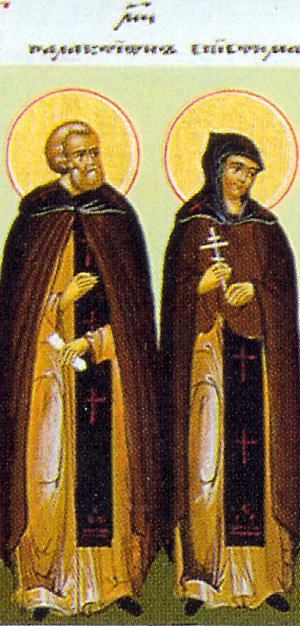
Martyrs Galacteon and Wife Epistemis
A pagan couple, Cleitophon and Leucippe, who lived in Emesa in the reign of the Emperor Decius, were grieved that they were unable to have children. One day a monk named Onuphrius came to their door seeking alms to give to the poor, and seeing Leucippe’s downcast face, asked her what was wrong. When she replied that she was barren, Onuphrius told her that this was by God’s providence, to prevent their child from being given over to idolatry, and that if they accepted Christ she would bear a child. Leu
A pagan couple, Cleitophon and Leucippe, who lived in Emesa in the reign of the Emperor Decius, were grieved that they were unable to have children. One day a monk named Onuphrius came to their door seeking alms to give to the poor, and seeing Leucippe’s downcast face, asked her what was wrong. When she replied that she was barren, Onuphrius told her that this was by God’s providence, to prevent their child from being given over to idolatry, and that if they accepted Christ she would bear a child. Leucippe was baptized into the Faith and bore a son not long after, which in turn brought her husband to faith in Christ. The son was named Galaction in baptism.
Years later, Galaction’s father, now widowed, decided that Galaction should marry a pagan maiden named Episteme. Galaction married out of obedience, but would not approach Episteme’s bed since she was a pagan. In time, he convinced her of the truth of the Faith and baptised her himself. Not long after she was told in a dream of the glory that awaits those who consecrate themselves wholly to God. When she told her husband of the dream, they both resolved to remain in virginity, settling in separate monastic communities near to one another.
In one of the Emperor’s persecutions of Christians, Galaction was seized by imperial soldiers and taken away to be killed. Episteme, told in a vision of his arrest, asked the blessing of her abbess to join him in martyrdom. Receiving it, she hurried to Galaction’s place of imprisonment, boldly announced her faith in Christ, and after many tortures and humiliations husband and wife were beheaded together.
Troparion - Tone 4
Let us the faithful honor these two betrothed athletes: / Galaction and modest Episteme. / Their ascetic labors blossomed into martyrdom, therefore we cry to them: / “Glory to Him who has strengthened you! / Glory to Him who has crowned you! / Glory to Him who through you grants healing to all!”
Kontakion - Tone 2
Your holy martyrs, O Lord, / through their sufferings have received incorruptible crowns from You, our God. / For having Your strength, they laid low their adversaries, / and shattered the powerless boldness of demons. / Through their intercessions, save our souls!
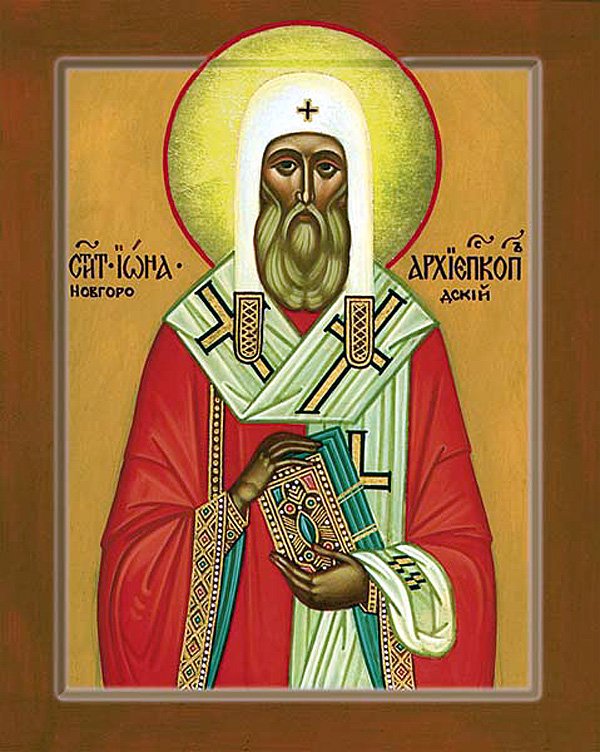
Repose St Jonah of Novgorod
Saint Jonah, Archbishop of Novgorod, in the world named John, was left orphaned early in life and was adopted by a certain pious widow living in Novgorod. She raised the child and sent him to school. Blessed Michael of Klops Monastery (January 11), who chanced to meet John on the street, foretold that he would become Archbishop of Novgorod.
Saint Jonah, Archbishop of Novgorod, in the world named John, was left orphaned early in life and was adopted by a certain pious widow living in Novgorod. She raised the child and sent him to school. Blessed Michael of Klops Monastery (January 11), who chanced to meet John on the street, foretold that he would become Archbishop of Novgorod. John received tonsure at the Otnya wilderness-monastery, 50 versts from the city, and he became igumen of this monastery. It was from here that the people of Novgorod chose him as their archbishop in 1458, after the death of Saint Euthymius (March 11).
Saint Jonah enjoyed great influence at Moscow, and during his time as hierarch, the Moscow princes did not infringe upon the independence of Novgorod. Saint Jonah, Metropolitan of Moscow (1449-1461), was a friend of the Novgorod Archbishop Saint Jonah, and wanted him to become his successor.
In 1463, Archbishop Jonah built the first church dedicated to Saint Sergius of Radonezh in the Novgorod region. Concerning himself over reviving traditions of the old days in the Novgorod Church, he summoned to Novgorod the renowned compiler of Saints’ Lives, Pachomius the Logothete, who wrote both the services and history of the best known Novgorod Saints, based on local sources.
And to this time period belongs also the founding of the Solovki monastery. Saint Jonah rendered much help and assistance in the organizing of the monastery. To Saint Zosimas he gave a special land-grant (in conjunction with the secular authorities of Novgorod), by which the whole of Solovki Island was granted to the new monastery.
The saint, after his many toils, and sensing the approach of his end, wrote a spiritual testament to bury his body at the Otnya monastery. On November 5, 1470, after he received the Holy Mysteries, the saint fell asleep in the Lord.
There has survived to the present day a Letter of Saint Jonah to Metropolitan Theodosius, written in 1464. The Life of the saint was written in the form of a short account in the year 1472 (included in the work, Memorials of Old Russian Literature, and also in the Great Reading Menaion of Metropolitan Macarius, under November 5). In 1553, after the uncovering of the relics of Archbishop Jonah, an account of this event was written by Saint Zenobius of Otnya (October 30). A special work relating the miracles of the saint is found in manuscripts of the seventeenth century.
Troparion - Tone 4
In truth you were revealed to your flock as a rule of faith, / an image of humility and a teacher of abstinence; / your humility exalted you; / your poverty enriched you. / Hierarch Father Jonah, / entreat Christ our God / that our souls may be saved.
Holy Martyrs Galaction and Episteme (ca. 250)
A pagan couple, Cleitophon and Leucippe, who lived in Emesa in the reign of the Emperor Decius, were grieved that they were unable to have children. One day a monk named Onuphrius came to their door seeking alms to give to the poor, and seeing Leucippe’s downcast face, asked her what was wrong. When she replied that she was barren, Onuphrius told her that this was by God’s providence, to prevent their child from being given over to idolatry, and that if they accepted Christ she would bear a child. Leu
A pagan couple, Cleitophon and Leucippe, who lived in Emesa in the reign of the Emperor Decius, were grieved that they were unable to have children. One day a monk named Onuphrius came to their door seeking alms to give to the poor, and seeing Leucippe’s downcast face, asked her what was wrong. When she replied that she was barren, Onuphrius told her that this was by God’s providence, to prevent their child from being given over to idolatry, and that if they accepted Christ she would bear a child. Leucippe was baptized into the Faith and bore a son not long after, which in turn brought her husband to faith in Christ. The son was named Galaction in baptism.
Years later, Galaction’s father, now widowed, decided that Galaction should marry a pagan maiden named Episteme. Galaction married out of obedience, but would not approach Episteme’s bed since she was a pagan. In time, he convinced her of the truth of the Faith and baptised her himself. Not long after she was told in a dream of the glory that awaits those who consecrate themselves wholly to God. When she told her husband of the dream, they both resolved to remain in virginity, settling in separate monastic communities near to one another.
In one of the Emperor’s persecutions of Christians, Galaction was seized by imperial soldiers and taken away to be killed. Episteme, told in a vision of his arrest, asked the blessing of her abbess to join him in martyrdom. Receiving it, she hurried to Galaction’s place of imprisonment, boldly announced her faith in Christ, and after many tortures and humiliations husband and wife were beheaded together.
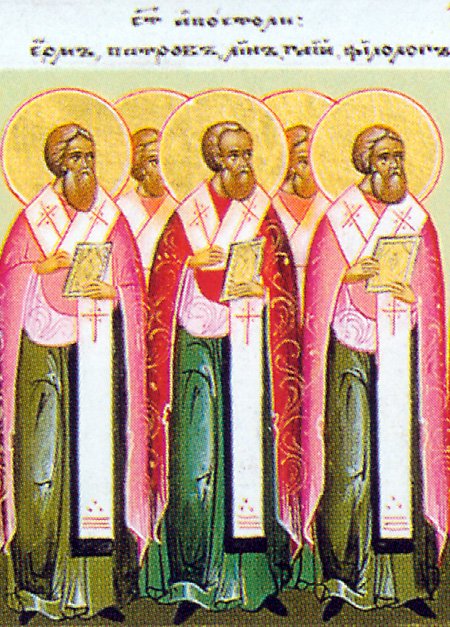
Holy Apostles Patrobas, Hermas, Linus, Gaius and Philologus
They are numbered among the Seventy Disciples of the Lord.
Saint Hermas and Saint Patrobolus are both mentioned by St Paul in Romans 16:4. Saint Hermas became Bishop of Philippi. Some believe him to be the author of The Shepherd, which was so cherished by the early Church that is included in some early versions of the New Testament.
They are numbered among the Seventy Disciples of the Lord.
Saint Hermas and Saint Patrobolus are both mentioned by St Paul in Romans 16:4. Saint Hermas became Bishop of Philippi. Some believe him to be the author of The Shepherd, which was so cherished by the early Church that is included in some early versions of the New Testament. Saint Patrobolus became Bishop of Pozzuoli in Italy.
Saint Linus (mentioned in 2 Timothy 4:21) was ordained by St Peter as first Bishop of Rome. He was martyred, perhaps in AD 76.
Saint Gaius (mentioned in Romans 16:23, where we learn that St Paul stayed with him in Corinth), succeeded St Timothy as Bishop of Ephesus.
Saint Philologus (mentioned in Romans 16:15), was made Bishop of Sinope in Pontus by the Apostle Andrew.
Troparion - Tone 3
Holy Apostles Patrobus, Hermes, Linus, Gaius, and Philologus, / entreat the merciful God, / to grant our souls forgiveness of transgressions.
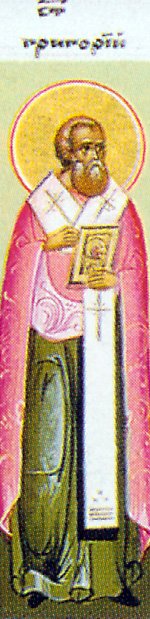
Our Holy Father Gregory the Confessor, Patriarch of Alexandria (early 9th c.)
This much-loved shepherd of the Church at Alexandria was unanimously elected to the Patriarchate by the Bishops and people of that city. Though meek and humble, he was a fierce defender of holy Orthodoxy, which was then under attack by the Emperor Leo the Armenian (813-820). For his fearless defense of the holy Icons, Gregory was arrested at the Emperor’s orders and brought in chains to Constantinople. B
This much-loved shepherd of the Church at Alexandria was unanimously elected to the Patriarchate by the Bishops and people of that city. Though meek and humble, he was a fierce defender of holy Orthodoxy, which was then under attack by the Emperor Leo the Armenian (813-820). For his fearless defense of the holy Icons, Gregory was arrested at the Emperor’s orders and brought in chains to Constantinople. Brought before Leo, the holy Patriarch told him clearly that he was a heretic and an enemy of the Church. The enraged Emperor had Gregory scourged, then sent into exile, where he reposed three years later.
Troparion - Tone 4
By sharing in the ways of the Apostles, / you became a successor to their throne. / Through the practice of virtue, you found the way to divine contemplation, / O inspired one of God; / by teaching the word of truth without error, / you defended the Faith, even to the shedding of your blood. / Hieromartyr Gregory entreat Christ God to save our souls.
Scripture Readings
☩Epistle
1 Thessalonians 2:9-14
9
For ye remember, brethren, our labour and travail: for labouring night and day, because we would not be chargeable unto any of you, we preached unto you the gospel of God.
10
Ye are witnesses, and God also, how holily and justly and unblameably we behaved ourselves among you that believe:
11
As ye know how we exhorted and comforted and charged every one of you, as a father doth his children,
12
That ye would walk worthy of God, who hath called you unto his kingdom and glory.
13
For this cause also thank we God without ceasing, because, when ye received the word of God which ye heard of us, ye received it not as the word of men, but as it is in truth, the word of God, which effectually worketh also in you that believe.
14
For ye, brethren, became followers of the churches of God which in Judea are in Christ Jesus: for ye also have suffered like things of your own countrymen, even as they have of the Jews:
☩Gospel
Luke 11:47-12:1
47
Woe unto you! for ye build the sepulchres of the prophets, and your fathers killed them.
48
Truly ye bear witness that ye allow the deeds of your fathers: for they indeed killed them, and ye build their sepulchres.
49
Therefore also said the wisdom of God, I will send them prophets and apostles, and some of them they shall slay and persecute:
50
That the blood of all the prophets, which was shed from the foundation of the world, may be required of this generation;
51
From the blood of Abel unto the blood of Zacharias, which perished between the altar and the temple: verily I say unto you, It shall be required of this generation.
52
Woe unto you, lawyers! for ye have taken away the key of knowledge: ye entered not in yourselves, and them that were entering in ye hindered.
53
And as he said these things unto them, the scribes and the Pharisees began to urge him vehemently, and to provoke him to speak of many things:
54
Laying wait for him, and seeking to catch something out of his mouth, that they might accuse him.
1
In the mean time, when there were gathered together an innumerable multitude of people, insomuch that they trode one upon another, he began to say unto his disciples first of all, Beware ye of the leaven of the Pharisees, which is hypocrisy.
Liturgical data sourced from OCA.org and orthocal.info