
Fasting Rules
 Meat
Allowed
 Fish
Allowed
 Dairy
Allowed
 Oil
Allowed
 Wine
Allowed
Saints & Commemorations
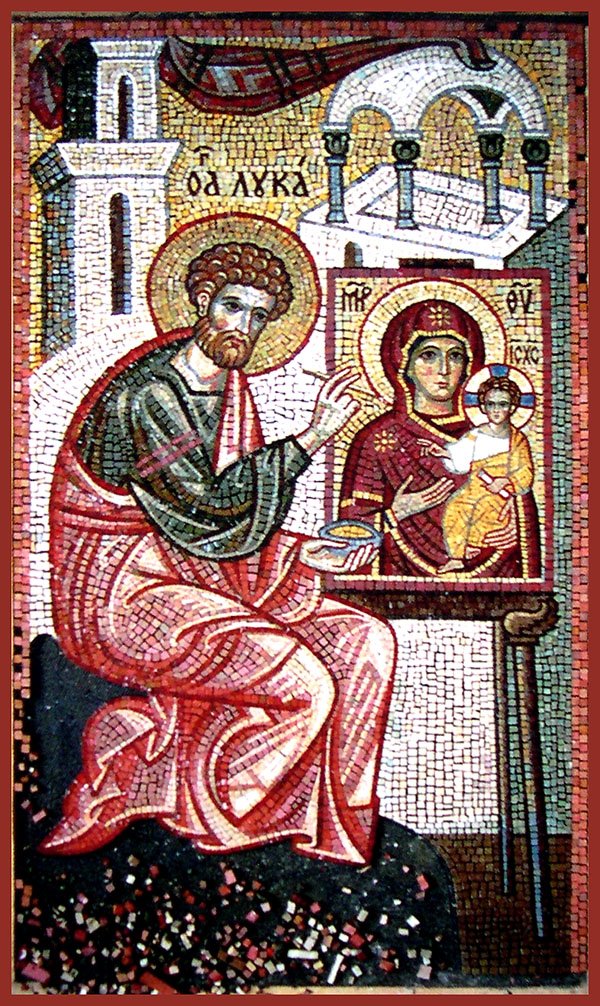
Holy Apostle and Evangelist Luke
The Holy Apostle and Evangelist Luke, was a native of Syrian Antioch, a companion of the holy Apostle Paul (Phil.1:24, 2 Tim. 4:10-11), and a physician enlightened in the Greek medical arts. Hearing about Christ, Luke arrived in Palestine and fervently accepted the preaching of salvation from the Lord Himself.
The Holy Apostle and Evangelist Luke, was a native of Syrian Antioch, a companion of the holy Apostle Paul (Phil.1:24, 2 Tim. 4:10-11), and a physician enlightened in the Greek medical arts. Hearing about Christ, Luke arrived in Palestine and fervently accepted the preaching of salvation from the Lord Himself. As one of the Seventy Apostles, Saint Luke was sent by the Lord with the others to preach the Kingdom of Heaven during the Savior’s earthly life (Luke 10:1-3). After the Resurrection, the Lord Jesus Christ appeared to Saints Luke and Cleopas on the road to Emmaus.
Luke accompanied Saint Paul on his second missionary journey, and from that time they were inseparable. When Paul’s coworkers had forsaken him, only Luke remained to assist him in his ministry (2 Tim. 4:10-11). After the martyric death of the First-Ranked Apostles Peter and Paul, Saint Luke left Rome to preach in Achaia, Libya, Egypt and the Thebaid. He ended his life by suffering martyrdom in the city of Thebes.
Tradition credits Saint Luke with painting the first icons of the Mother of God. “Let the grace of Him Who was born of Me and My mercy be with these Icons,” said the All-Pure Virgin after seeing the icons. Saint Luke also painted icons of the First-Ranked Apostles Peter and Paul. Saint Luke’s Gospel was written in the years 62-63 at Rome, under the guidance of the Apostle Paul. In the preliminary verses (1:1-3), Saint Luke precisely sets forth the purpose of his work. He proposes to record, in chronological order, everything known by Christians about Jesus Christ and His teachings. By doing this, he provided a firmer historical basis for Christian teaching (1:4). He carefully investigated the facts, and made generous use of the oral tradition of the Church and of what the All-Pure Virgin Mary Herself had told him (2:19, 51).
In Saint Luke’s Gospel, the message of the salvation made possible by the Lord Jesus Christ, and the preaching of the Gospel, are of primary importance.
Saint Luke also wrote the Acts of the Holy Apostles at Rome around 62-63 A.D. The Book of Acts, which is a continuation of the four Gospels, speaks about the works and the fruits of the holy Apostles after the Ascension of the Savior. At the center of the narrative is the Council of the holy Apostles at Jerusalem in the year 51, a Church event of great significance, which resulted in the separation of Christianity from Judaism and its independent dissemination into the world (Acts 15:6-29). The theological focus of the Book of Acts is the coming of the Holy Spirit, Who will guide the Church “into all truth” (John 16:13) until the Second Coming of Christ.
The holy relics of Saint Luke were taken from Constantinople and brought to Padua, Italy at some point in history. Perhaps this was during the infamous Crusade of 1204. In 1992, Metropolitan Hieronymus (Jerome) of Thebes requested the Roman Catholic bishop in Thebes to obtain a portion of Saint Luke’s relics for the saint’s empty sepulchre in the Orthodox cathedral in Thebes.
The Roman Catholic bishop Antonio Mattiazzo of Padua, noting that Orthodox pilgrims came to Padua to venerate the relics while many Catholics did not even know that the relics were there, appointed a committee to investigate the relics in Padua, and the skull of Saint Luke in the Catholic Cathedral of Saint Vico in Prague.
The skeleton was determined to be that of an elderly man of strong build. In 2001, a tooth found in the coffin was judged to be consistent with the DNA of Syrians living near the area of Antioch dating from 72-416 A.D. The skull in Prague perfectly fit the neck bone of the skelton. The tooth found in the coffin in Padua was also found to fit the jawbone of the skull.
Bishop Mattiazzo sent a rib from the relics to Metropolitan Hieronymus to be venerated in Saint Luke’s original tomb in the Orthodox cathedral at Thebes.
Saint Luke is also commemorated on April 22.
Troparion - Tone 5
Let us praise with sacred songs the holy Apostle Luke, / the recorder of the joyous Gospel of Christ / and the scribe of the Acts of the Apostles, / for his writings are a testimony of the Church of Christ: / He is the physician of human weaknesses and infirmities. / He heals the wounds of our souls, / and constantly intercedes for our salvation!
Kontakion - Tone 2
Let us praise the godly Luke: / he is the true preacher of piety, / the orator of ineffable mysteries / and the star of the Church; / for the Word, Who alone knows the hearts of men, / chose him, together with wise Paul, to be a teacher of the gentiles!
Marinos the Martyr
Resurrection Mode 3
Scripture Readings
☩Epistle
Galatians 1:11-19
11
But I certify you, brethren, that the gospel which was preached of me is not after man.
12
For I neither received it of man, neither was I taught it, but by the revelation of Jesus Christ.
13
For ye have heard of my conversation in time past in the Jews’ religion, how that beyond measure I persecuted the church of God, and wasted it:
14
And profited in the Jews’ religion above many my equals in mine own nation, being more exceedingly zealous of the traditions of my fathers.
15
But when it pleased God, who separated me from my mother’s womb, and called me by his grace,
16
To reveal his Son in me, that I might preach him among the heathen; immediately I conferred not with flesh and blood:
17
Neither went I up to Jerusalem to them which were apostles before me; but I went into Arabia, and returned again unto Damascus.
18
Then after three years I went up to Jerusalem to see Peter, and abode with him fifteen days.
19
But other of the apostles saw I none, save James the Lord’s brother.
☩Gospel
Luke 8:5-15
5
A sower went out to sow his seed: and as he sowed, some fell by the way side; and it was trodden down, and the fowls of the air devoured it.
6
And some fell upon a rock; and as soon as it was sprung up, it withered away, because it lacked moisture.
7
And some fell among thorns; and the thorns sprang up with it, and choked it.
8
And other fell on good ground, and sprang up, and bare fruit an hundredfold. And when he had said these things, he cried, He that hath ears to hear, let him hear.
9
And his disciples asked him, saying, What might this parable be?
10
And he said, Unto you it is given to know the mysteries of the kingdom of God: but to others in parables; that seeing they might not see, and hearing they might not understand.
11
Now the parable is this: The seed is the word of God.
12
Those by the way side are they that hear; then cometh the devil, and taketh away the word out of their hearts, lest they should believe and be saved.
13
They on the rock are they, which, when they hear, receive the word with joy; and these have no root, which for a while believe, and in time of temptation fall away.
14
And that which fell among thorns are they, which, when they have heard, go forth, and are choked with cares and riches and pleasures of this life, and bring no fruit to perfection.
15
But that on the good ground are they, which in an honest and good heart, having heard the word, keep it, and bring forth fruit with patience.
Liturgical data sourced from OCA.org and orthocal.info