
Fasting Rules
 Meat
Allowed
 Fish
Allowed
 Dairy
Allowed
 Oil
Allowed
 Wine
Allowed
Saints & Commemorations
St Romanos the Melodist of Constantinople (556)
He was born in Emessa in Syria, probably of Jewish parents. He served as a deacon in Beirut, then in Constantinople at the time of Patriarch Euphemius (490-496). He was illiterate, had no musical training, and was a poor singer; thus he was despised by many of the more cultivated clergy. One night, after Romanos had prayed to the Mother of God, she appeared to him in a dream, held out a piece of paper and told him to swallow it.
He was born in Emessa in Syria, probably of Jewish parents. He served as a deacon in Beirut, then in Constantinople at the time of Patriarch Euphemius (490-496). He was illiterate, had no musical training, and was a poor singer; thus he was despised by many of the more cultivated clergy. One night, after Romanos had prayed to the Mother of God, she appeared to him in a dream, held out a piece of paper and told him to swallow it. On the following day, the Nativity of Christ, Romanos went to the ambon and, with an angelic voice, sang ‘Today the Virgin…’, which is still sung as the Kontakion of the Feast. All present were amazed at the completely unexpected beauty of the hymn and of Romanos’ singing. St Romanos went on to compose more than a thousand Kontakia (which were once long hymns, not the short verses used in church today). He is almost certainly the author of the sublime Akathist Hymn to the Mother of God, which has served as the model for all other Akathists. He reposed in peace, while still a deacon of the Great Church in Constantinople. Many of his hymns were inspired by the hymns of St Ephraim of Syria.
The influence of Middle Eastern music on the hymnography of the Church is incalculable. Many of those who established the form of the Church’s music were Syrians: two noted examples are St Romanos and St John of Damascus, who composed the Octoechos, the Pascha service, and the Funeral Service. Their music was in turn modeled on the music of the Hebrew temple. The Byzantine musical tradition has descended without break from the music sung in Christ’s time, and presumably by Christ Himself.
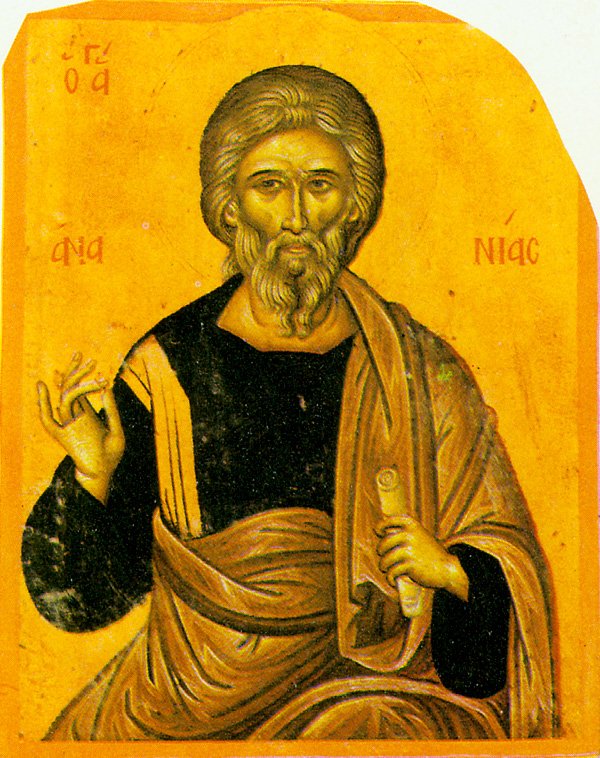
Holy Apostle Ananias of the Seventy
The Holy Apostle Ananias of the Seventy (October 1), was the first Bishop of Damascus. The Lord ordered him to restore the sight of Saul, the former persecutor of Christians, then baptize him (Acts 9:10-19, 22:12). Saul became the great preacher and Apostle Paul. Saint Ananias boldly and openly confessed Christianity before the Jews and the pagans, despite the danger.
The Holy Apostle Ananias of the Seventy (October 1), was the first Bishop of Damascus. The Lord ordered him to restore the sight of Saul, the former persecutor of Christians, then baptize him (Acts 9:10-19, 22:12). Saul became the great preacher and Apostle Paul. Saint Ananias boldly and openly confessed Christianity before the Jews and the pagans, despite the danger.
From Damascus he went to preach at Eleutheropolis, where he healed many of their infirmities. Lucian, the prefect of the city, tried to persuade the holy one to offer sacrifice to idols. Because of Ananias’ staunch and solid confession of Christ, Lucian ordered that he be tortured. Harsh torments did not sway the witness of Truth. Then the torturers led him out beyond the city, where they stoned him. The saint prayed for those who put him to death. His relics were later transferred to Constantinople.
Troparion - Tone 3
Holy Apostle Ananias, / entreat the merciful God, / to grant our souls forgiveness of transgressions.
Protection (Pokrov) of the Most-Holy Theotokos
Scripture Readings
☩Epistle
Ephesians 5:33-6:9
33
Nevertheless let every one of you in particular so love his wife even as himself; and the wife see that she reverence her husband.
1
Children, obey your parents in the Lord: for this is right.
2
Honour thy father and mother; (which is the first commandment with promise;)
3
That it may be well with thee, and thou mayest live long on the earth.
4
And, ye fathers, provoke not your children to wrath: but bring them up in the nurture and admonition of the Lord.
5
Servants, be obedient to them that are your masters according to the flesh, with fear and trembling, in singleness of your heart, as unto Christ;
6
Not with eyeservice, as menpleasers; but as the servants of Christ, doing the will of God from the heart;
7
With good will doing service, as to the Lord, and not to men:
8
Knowing that whatsoever good thing any man doeth, the same shall he receive of the Lord, whether he be bond or free.
9
And, ye masters, do the same things unto them, forbearing threatening: knowing that your Master also is in heaven; neither is there respect of persons with him.
☩Gospel
Luke 6:12-19
12
And it came to pass in those days, that he went out into a mountain to pray, and continued all night in prayer to God.
13
And when it was day, he called unto him his disciples: and of them he chose twelve, whom also he named apostles;
14
Simon, (whom he also named Peter,) and Andrew his brother, James and John, Philip and Bartholomew,
15
Matthew and Thomas, James the son of Alpheus, and Simon called Zelotes,
16
And Judas the brother of James, and Judas Iscariot, which also was the traitor.
17
And he came down with them, and stood in the plain, and the company of his disciples, and a great multitude of people out of all Judea and Jerusalem, and from the sea coast of Tyre and Sidon, which came to hear him, and to be healed of their diseases;
18
And they that were vexed with unclean spirits: and they were healed.
19
And the whole multitude sought to touch him: for there went virtue out of him, and healed them all.
Liturgical data sourced from OCA.org and orthocal.info